
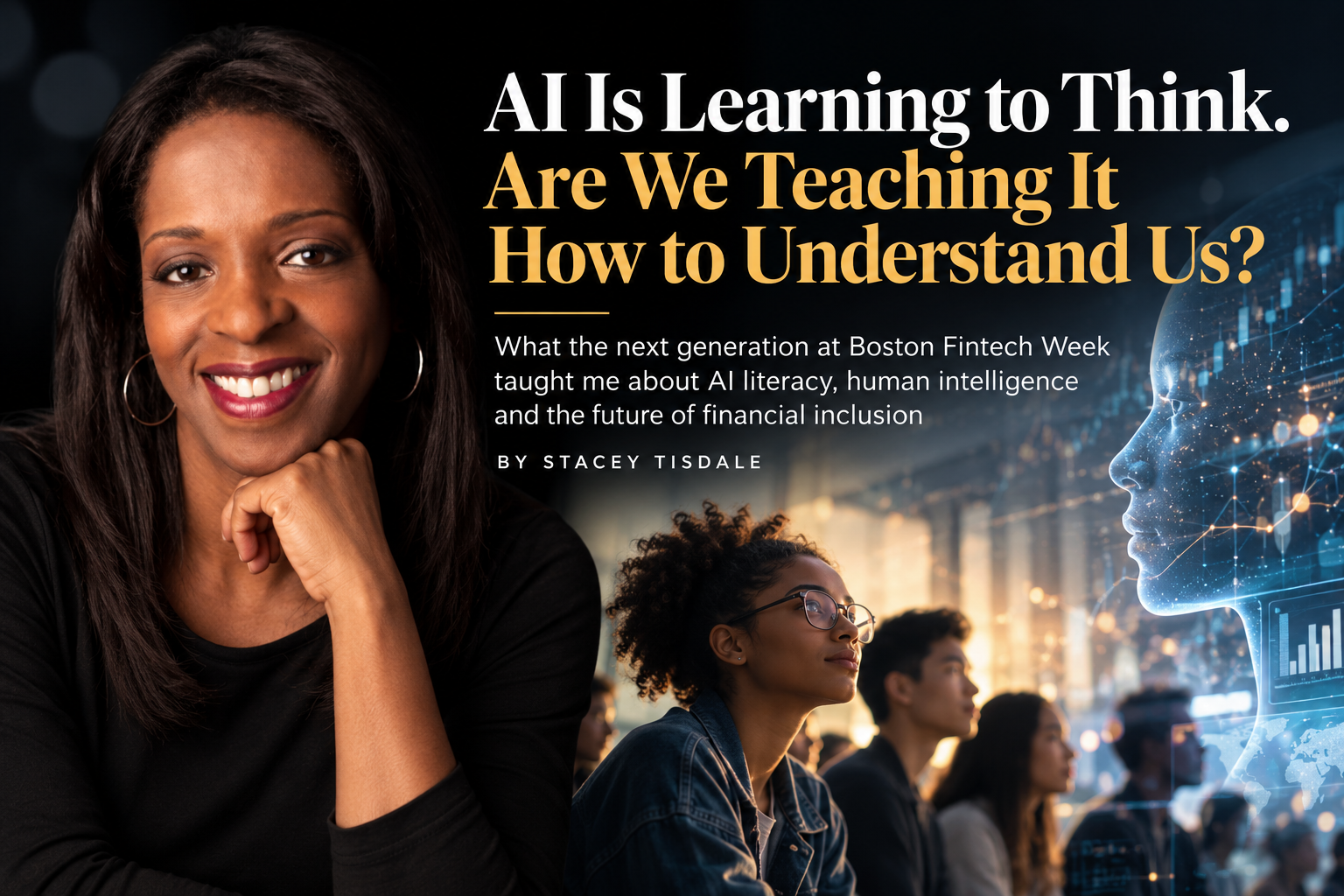
AI Is Learning to Think. Are We Teaching It How to Understand Us?
What the next generation at Boston Fintech Week taught me about AI literacy, human intelligence and the future of financial inclusion
By Stacey Tisdale
Financial Behavior Expert, Journalist and Co-Host of Wealth Wednesdays with Angela Yee
I went to Boston Fintech Week expecting to spend a lot of time thinking about artificial intelligence.
I left thinking about literacy.
Not literacy in the traditional sense. I mean something I’ve come to think of more broadly:
Literacy is collaboration with knowledge.
For example, financial literacy isn’t simply possessing financial information. It is developing enough understanding to engage with that information, question it, apply it and use it to make better decisions.
AI literacy demands something similar.
Artificial intelligence is already embedded in our financial lives and in the institutions, technologies and systems that increasingly shape them. The question isn’t whether AI will change finance. That transformation is already underway.
The question that stayed with me after Boston was more human:
Are we learning how to collaborate with it?
The conversations I keep thinking about
Some of my favorite conversations in Boston weren’t scheduled.
They happened with students.
Boston Fintech Week intentionally brings students into the fintech ecosystem. They weren’t standing outside the industry’s conversations looking in. They were having them.
What struck me wasn’t simply that these young people were comfortable with AI.
It was how naturally many of them seemed to understand the relationship they wanted to have with it.
They were enthusiastic about its possibilities, but they also seemed to understand that the quality of what AI gives us depends, in part, on what human beings bring to it.
They saw collaboration.
And collaboration requires contribution from both sides.
That matters because these are tomorrow’s entrepreneurs, founders, technologists, financial professionals and leaders. They won’t simply use the systems being created today. Some of them will build what comes next.
Listening to them crystallized something for me:
AI literacy isn’t learning how to get AI to give you an answer.
It is learning how to bring enough of yourself to the interaction to make the answer valuable.
Fintech That Thinks
That idea felt particularly appropriate at the 2026 Boston Fintech Week Innovation Forum, presented by Fintech Sandbox and hosted at the Federal Reserve Bank of Boston.
This year’s theme was Fintech That Thinks, and over the course of the day I heard conversations spanning AI agents, asset management, transactions, banking, compliance, open-source technology and the infrastructure underlying our financial lives.
Fintech Sandbox, the nonprofit behind Boston Fintech Week, is built around expanding access to innovation by helping fintech entrepreneurs gain access to the data they need to build and test new ideas.
There is a philosophy underneath that model that seemed to run through the day:
Innovation requires access.
Access to technology. Access to information. Access to people. And, as the students reminded me, access to the rooms where the future is being shaped.
Collaboration with knowledge
I have spent much of my career thinking about financial literacy and financial behavior, and Boston made me realize that the definition of literacy itself needs to expand.
AI can synthesize extraordinary amounts of information. It can compare, calculate, challenge and surface possibilities we hadn’t considered.
But collaboration isn’t simply about what AI knows.
It’s also about what we tell it.
That may be particularly important for people who haven’t always felt comfortable engaging with the financial system.
Someone embarrassed about debt may tell an AI.
Someone afraid to admit they don’t understand investing may ask an AI.
Someone carrying family financial obligations, cultural expectations or financial anxiety may share context they have never shared with a financial professional.
AI could become a remarkably safe place to begin.
And that makes AI literacy about more than learning how to ask AI good questions.
We also have to teach people that their voice belongs in the conversation.
Their history matters. Their family experience matters. Their culture, circumstances, fears, goals and reasons for making the choices they make can matter.
If AI doesn’t know those things, it can’t take them into account.
And if the people building these systems don’t know to ask about them, we can’t assume the technology somehow will.
The next generation is already in the room
What makes all of this especially exciting is seeing efforts already underway to give the next generation more than education about this future.
They’re being given access to it.
The Georgia Fintech Academy, led by Laura Gibson-Lamothe, connects students across the University System of Georgia with fintech education, employers and experiential learning. Gibson-Lamothe and Robert “Red” Daniel are also members of the founding committee behind Atlanta Fintech Week, which begins September 28 and brings students and emerging talent into an ecosystem alongside entrepreneurs, founders, financial institutions, investors and innovators.
It’s the same spirit I experienced with the students in Boston.
They’re not simply learning about a financial and technological future someone else is building. They’re being given the knowledge, exposure and access to participate in building it.
And perhaps that’s what education for this moment requires.
Give the next generation access to the knowledge.
Give them access to the people.
Give them access to the rooms.
Then let them bring something equally important to the table:
Themselves.
I left Boston enormously optimistic.
The students I met seemed to understand something that all of us will need to learn: AI literacy isn’t simply about understanding what this technology can do.
It’s about understanding what we bring to the collaboration.
And as AI becomes more deeply embedded in our financial lives, we have another responsibility: making sure the people it serves have the knowledge and confidence to bring their voices into that collaboration, too.
AI is learning to think.
What we teach it about people matters.
Stacey Tisdale is an award-winning financial journalist, financial behavior expert, author and Founder & CEO of Mind Money Media, Inc. She is the creator and co-host of Wealth Wednesdays with Angela Yee & Stacey Tisdale, nationally distributed across iHeartMedia broadcast and digital platforms. Her work explores the psychological, emotional and behavioral dimensions of financial decision-making and how education, technology and media can help people translate financial access into action.