
Fintech’s Next Frontier: Inner Space - Human Decision-Making
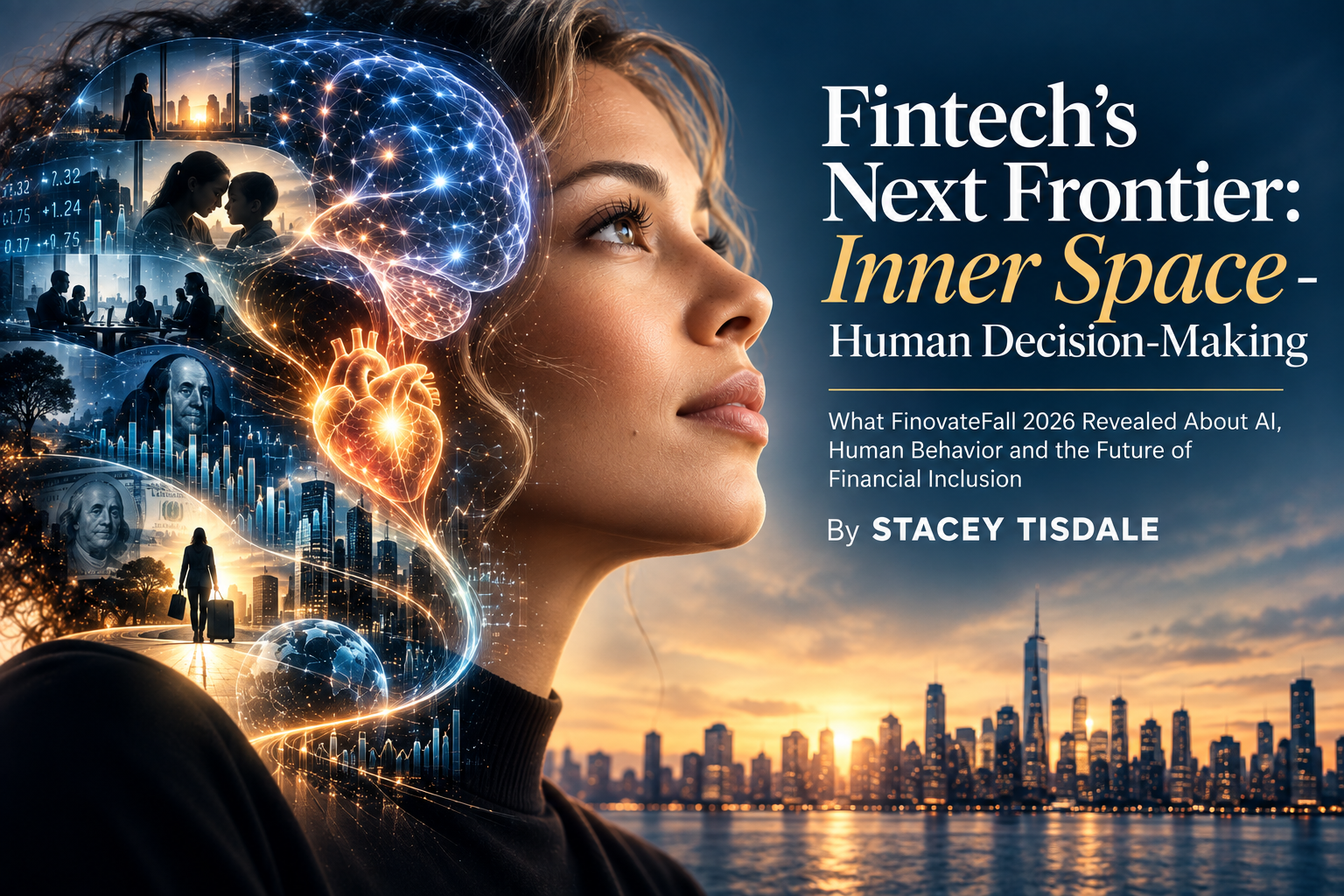
What FinovateFall 2026 Revealed About AI, Human Behavior and the Future of Financial Inclusion
By Stacey Tisdale
Financial Behavior Expert, Journalist and Co-Host of Wealth Wednesdays with Angela Yee
I went to FinovateFall 2026 in New York expecting to see the future of financial technology.
What I found was something bigger.
Over three days of live demos, panels and conversations with founders, financial services leaders and innovators, Finovate did what the best gatherings do: it changed the questions I was asking.
I arrived thinking about technology.
I left thinking about human nature.
Across demonstrations and conversations, I kept noticing the same thing. Some of the most interesting innovations were not simply helping financial institutions process more information, move money faster or build more sophisticated products.
They were trying to understand us.
When do we make our best decisions? What makes us act impulsively? What causes us to freeze? How do emotion, stress, identity and context influence a financial choice? And how can technology recognize those moments early enough to help?
At a moment when some of technology’s biggest ambitions are aimed toward outer space, I found myself thinking about another frontier.
Inner space.
The complicated terrain of human thought, emotion, identity and decision-making.
And financial technology may be taking us there faster than we realize.
Financial information was never the whole problem
I have spent more than two decades studying the psychological, emotional and behavioral forces that shape our relationship with money.
One lesson has remained remarkably consistent throughout that work:
Knowing what to do and being able to do it are two very different things.
We can give someone access to a financial product. We can teach them how it works. We can put a calculator in their hands, an app on their phone and information at their fingertips.
But none of those things automatically removes fear, shame, scarcity, distrust, trauma, decision fatigue or the deeply conditioned beliefs that can influence what happens next.
That is why I have increasingly come to think of financial inclusion as having at least two dimensions.
There is the critically important work of creating access.
And then there is the equally important work of helping people become psychologically, emotionally and behaviorally prepared to act on the opportunities that access creates.
That second frontier was everywhere I looked at FinovateFall.
Technology is beginning to meet us at the moment of decision
One of the demonstrations that stayed with me came from Finzee founder Michelle Soto.
Her technology incorporates biometric information to help identify when someone may be in a better state to make a financial decision, or when they may be more susceptible to an impulsive one.
Think about what that represents.
For decades, much of financial education has operated on the assumption that if we give people better information, they will make better decisions.
Behavioral science has long told us otherwise.
Now technology is developing the ability to recognize some of the conditions surrounding the decision itself.
That creates extraordinary possibilities.
It also creates extraordinary responsibility.
Because the question is no longer simply:
What can technology know about us?
It is becoming:
What should technology do with what it knows?
AI can create a different kind of safe space
This question has particular implications for communities that have historically felt judged, excluded or misunderstood by financial systems.
There are financial questions people do not ask because they are embarrassed.
There are mistakes they do not admit because they fear judgment.
There are conversations about money, debt, wealth, family obligations and even success that carry cultural and emotional dimensions that a traditional financial interface may never see.
Responsibly designed AI offers an intriguing possibility: a private space in which someone can explore what is happening internally before making a consequential financial decision.
Not an AI system pretending to be a financial adviser.
Not technology replacing human expertise.
Something different.
A thought and reflection partner that can help someone recognize what may be influencing a decision, slow down when necessary, ask better questions and become better prepared to engage with the expertise, support and resources that can actually move them forward.
A bridge to human expertise, not a replacement for it.
That distinction matters enormously.
We have been here before
Almost exactly a year ago, I found myself asking related questions while creating and moderating a panel for the 2025 UN Science Summit called The Next GDP: AI, Human-Centered Value Creation, and the Roadmap to 2050.
I came out of that experience thinking about something I eventually called Put Your Why Into AI.
AI, after all, does not arrive with its own human purpose.
We give it one.
It reflects our questions, priorities, assumptions and values back to us, sometimes in ways that allow us to see ourselves more clearly.
One of the ideas I explored then was metacognition, our ability to think about our own thinking.
Our financial choices do not happen in a vacuum. They can be influenced by childhood scripts, cultural norms, gender roles, fears, biases and the experiences that have shaped what money means to us.
So what happens when technology gives us a way to examine those influences closer to the moment when we are actually making a decision?
A year ago, that was largely a question for me.
At FinovateFall, I began seeing pieces of the answer being built.
What if we could bring behavioral reflection closer to the actual moment when a financial decision is being made?
What if technology could help us create enough mental and emotional space to make a different choice?
What if financial technology became not only smarter about our money, but more thoughtful about our humanity?
The next financial inclusion challenge may be wealth itself
There was another theme beneath many of my conversations at FinovateFall that deserves much more attention.
Across multicultural and historically underrepresented communities, tremendous entrepreneurial energy is creating a new generation of first-generation wealth creators.
That is an extraordinary achievement.
It also creates an entirely new set of behavioral challenges.
Creating wealth and being conditioned to manage, scale and transfer wealth are not the same thing.
I see this in my work with entrepreneurs. I have seen versions of it in my work around the financial behavior of professional athletes.
First-generation wealth often means learning, in real time, the scripts that families with multigenerational wealth may have had generations to develop: delegation, investing, risk, leadership, succession, estate planning, family expectations and legacy.
The financial services institution that truly understands this transition, not merely as an asset acquisition opportunity but as a human transition, has an opportunity to lead an extraordinarily important conversation.
And I do not think anyone has fully claimed that mantle yet.
And then there is longevity
Another defining financial issue is coming toward us from the opposite end of the life cycle.
We are living longer.
That is a gift.
But longevity also means longer retirements, more years of caregiving, more complex family financial responsibilities and an expanding sandwich generation trying to simultaneously care for children, aging parents and themselves.
Again, the mathematics matter.
But so does the human behavior.
How do people make sound decisions when they are exhausted?
How does financial stress affect mental bandwidth?
What happens when family obligation collides with retirement security?
How do we design financial tools for people whose decisions are being made inside emotionally complicated lives?
These are not peripheral questions.
I believe they will become some of the defining financial questions of our time.
Technology may finally be able to keep up with our curiosity
That may be what excited me most about FinovateFall.
For much of my career, those of us studying financial behavior have had to examine the internal world indirectly through research, interviews, surveys, observation and conversation.
Now we are developing tools capable of responding to human context with a speed and level of personalization we have never had before.
That does not mean technology understands human beings.
We created it.
And we should never confuse a sophisticated mirror with the person standing in front of it.
But perhaps we have finally built something capable of keeping up with our curiosity about ourselves.
That is an extraordinary opportunity, as long as we remain clear about who is supposed to be serving whom.
The future of fintech will not be defined only by how intelligent our technology becomes.
It will also be defined by whether we use that intelligence to become more thoughtful about human beings.
That is the frontier I left FinovateFall most excited to explore.
And I suspect we are only beginning.
Thank you, FinovateFall
A special thank you to the Finovate team for creating a space where technology is not simply demonstrated, but examined, debated and imagined in the context of the people it is ultimately meant to serve.
The conversations I had in New York, with founders, innovators, financial services leaders and people thinking deeply about financial inclusion, reminded me why convenings like FinovateFall matter.
The best innovation does not simply give us new answers.
It gives us better questions.
And I left FinovateFall with plenty of them.
Stacey Tisdale is an award-winning financial journalist, financial behavior expert, author and Founder & CEO of Mind Money Media, Inc. She is the creator and co-host of Wealth Wednesdays with Angela Yee & Stacey Tisdale, nationally distributed across iHeartMedia broadcast and digital platforms. Her work explores the psychological, emotional and behavioral dimensions of financial decision-making and how education, technology and media can help people translate financial access into action.